Thursday, May 10, 2012

Nature Verses- CHRISTO & JeanClaude

Internationally acclaimed artists Christo and Jeanne-Claude spent more than 40 years creating highly celebrated works of art around the world. Together this unique, dynamic married couple changed the concept of “public art” by creating temporary works that are truly transitory by design.

Christo and Jeanne-Claude have never accepted, nor will Christo accept in the future, any subsidies, royalties, grants, or sponsorships of any kind for their temporary public works of art. Similarly, the artists do not make any endorsements of businesses, products, political movements, other artists, or anything else. All of the artists’ income is derived from the sale of original works of art by Christo to private collectors, galleries and museums. Christo and Jeanne-Claude have always maintained a position of total artistic freedom, with no constraints or financial considerations imposed upon their works of art by any outside party.
Over the River Project Site- August of 2015
Over The River is a two-week temporary work of art by the artists Christo and Jeanne-Claude. The project’s plans call for 5.9 miles of silvery, luminous fabric panels to be suspended high above the Arkansas River along a 42-mile stretch of the river between Salida and Cañon City in south-central Colorado. Fabric panels will be suspended at eight distinct areas of the river that were selected by the artists for their aesthetic merits and technical viability.
Overview of Christo's & Jean-Claude's work

Find examples of Christo and Jean Claude's work to add to your journal

Nature Verses Research Assignment

Research your Nature Verses project. Select at least one source to inspire and educate your project.
Take notes while you watch/read, and collect information for your project planning. Site the title and author of your research, describe what the document is about and what perspective the author takes on the issue, then note how it has influenced your project.
Due May 18th.
Film/Documentaries-
Dirt
No Impact Man
The Earthling (WARNING-real life horror film super scary!)
The Cove
Scared Sacred
Fierce Light
One Ocean (2 episodes)
FOOD Inc.
Our Daily Bread (warning- real life horror film)
Forks Over Knives
Force of Nature- Dr. David Suzuki
HOME by Yann Arthus Bertrand
Baraka
Koyaanisqatsi
Manufactured Landscapes
Inconvenient Truth- Al Gore
The Unforeseen
Sharkwater
Who Killed the Electric Car
Processed People

TED talks/short videos
Edward Burtynski- Photographer of industrial spaces
Phil Borges- Photographer
Wade Davis- National Geographic Explorer on Endangered Cultures
Mark Bittman- Cookbook Author-What is wrong with what we eat?
Jeremy Jackson- How we wrecked the ocean
Captain Charles Moore- Plastic in the ocean
Mike deGruy- Filming Octopus
Sylvia Earle- Protect Our Oceans
Dianna Cohen- Plastic Pollution Coalition
Chris Jordan- Photographer of Excess
Shai Agassi- Electric cars
John Robbins Part 1&2  Why I went vegetarian & What's wrong with eating animals
The Story of Stuff- Problems in Consuming
Story of Bottled Water
Story of Cosmetics
Story of Electronics
Articles/Publications
No Impact Man -Blog
Mother Earth News
The Guardian Environment
Vancouver Sun- Sharks
Globe and Mail- Biodiversity Conference
Globe and Mail- Price of Nature
NY Times- Environment Section
National Geographic
OnEarth
Emagazine
The Walrus- The Last Great Water Fight
Books
Silent Spring- Rachel Carson
Our Common Future
Manufactured Consent- Noam Chompsky
Diet for a New America- John Robbins
Walden, or Life in the Woods- Henry David Thoreau
Ishmael- Daniel Quinn
Animal, Vegetable, Mineral- Barbara Kingsolver
The World Without Us- 


Saturday, May 5, 2012

Nature Verses- ANDY GOLDSWORTHY

Andy Goldsworthy
Andy Goldsworthy is an extraordinary, innovative British artist whose collaborations with nature produce uniquely personal and intense artworks. Using a seemingly endless range of natural materials—snow, ice, leaves, bark, rock, clay, stones, feathers petals, twigs—he creates outdoor sculpture that manifests, however fleeting, a sympathetic contact with the natural world. Before they disappear, or as they disappear, Goldsworthy, records his work in suburb color photographs.
Andy Goldsworthy River & Tides1
Andy Goldsworthy River & Tides2
Rivers & Tides 3
Rivers & Tides4
Find examples of Andy Goldsworthy's work to add to your journal.

Nature Verses- Project Outline

Nature Verses is an exhibition showcasing the work of LFAS Photography students. The exhibition will consist of mini installations that respond to the environment. The great outdoors will be the venue (LFAS Court Yard).
The project questions and challenges the relationship between humans and nature. It’s the Canadian conundrum; the fine balance of peoples’ continuous struggles with the beauty, and the power of the environment. Students will respond to the works of Andy Goldsworthy, and Christo & Jean-Claude, and various other installation artists. The exhibition will be on-going for two weeks; nature may prevail and destroy the works; this harsh reality becomes part of the experience. Once the exhibition ends, there will be no evidence of its existence.
Materials & Construction Consider the following materials: fabric, photographs, paper, wood, rope, string, plastics, and metals. Bring all materials to create the installation and remove them when the exhibition is over. Students will not be permitted to alter or destroy anything on the school grounds.
Project Outline
Students are required to create a detailed plan in which they outline a proposal for an art installation in the school grounds. The installation will be in response to the environment and the chosen display area. When planning, consider renowned environmental installation artists: Andy Goldsworthy and Christo & Jean-Claude. Parents and friends are encouraged to participate.
Evaluation
The students will be marked on creativity, originality, successful implementation of their plan. The students’ artwork will express a clear message relating to the theme “Nature Verses”. The installation is respectful of the surrounding environment. The complete clean up of their installation area. Students will only receive a final grade when all evidence of the installation has been removed.

Monday, April 23, 2012

12 InfraRed Photography

WARNING several things to consider when shooting infrared:
  1. Keep infrared film cold.
  2. Load infrared film in complete darkness.
  3. Use a filter when shooting infrared film.
  4. Photograph in early or late day light, never at night, or mid-day.
  5. Choose landscapes, live things for your subject.
  6. Consider the sky- dramatic clouds look amazing.
  7. People look creepy- pale, eyes are black and veins are pronounced. 
In infrared photography, the film or image sensor used is sensitive to infrared light. The part of the spectrum used is referred to as near-infrared to distinguish it from far-infrared, which is the domain of thermal imaging. Wavelengths used for photography range from about 700 nanometre to about 900 nm. Film is usually sensitive to visible light too, so an infrared-passing filter is used; this lets infrared (IR) light pass through to the camera, but blocks all or most of the visible light spectrum (the filter thus looks black or deep red). ("Infrared filter" may refer either to such a filter or to one that blocks infrared but passes other wavelengths.)
When IR filters are used together with infrared-sensitive film or sensors, very interesting "in-camera effects" can be obtained; false-color or black-and-white images with a dreamlike or sometimes lurid effect mainly caused by foliage (such as tree leaves and grass) strongly reflecting in the same way visible light is reflected from snow. There is a small contribution from chlorophyll fluorescence, but this is marginal and is not the real cause of the brightness seen in infrared photographs
This is a BW Infrared project, but you are welcome to try digital infrared, but it seems that you need specialized/adapted camera equipment.
Here is an Infrared Photography site to check out: http://www.infraredphoto.eu/Site/GentleIntro1.html

Tuesday, April 3, 2012

12- Zone System Analysis

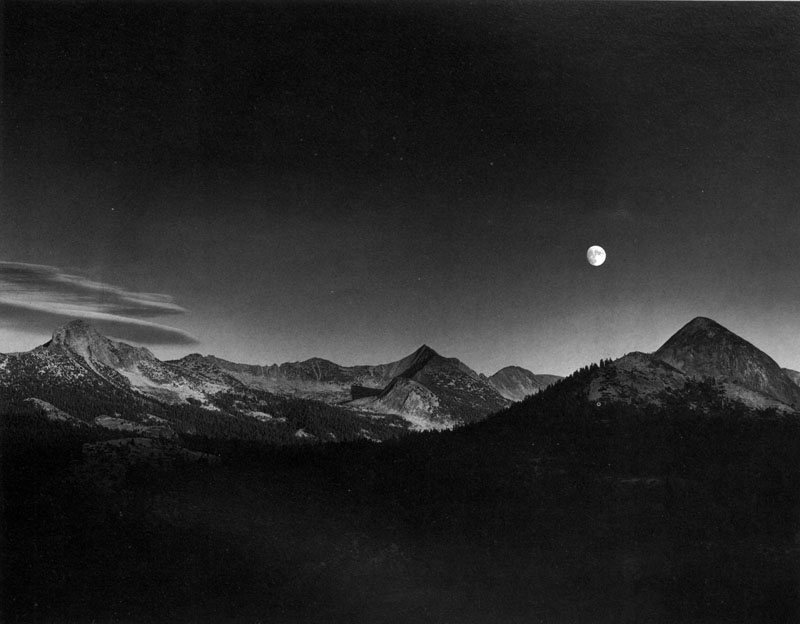
Choose one of the Ansel Adam's Landscape photos and identify the zones. You should have at least one of each of the zones: I, II, III, IV, V, VI, VII, VIII, IX, there likely will not be zones O or X. You can either save the image and indentify this in Photoshop, or on Word... Illustrator... then post to your Journal.